Masonry bonds are used to create a stable wall slab from individual masonry blocks, thus structurally transferring loads coming from above to the bottom and also stiffening the building against horizontal loads, e.g. due to wind pressure. A runner (shown in light) is a stone that is bricked lengthwise, and a truss or head (shown in dark) is a stone that is bricked transversely.
Modern masonry walls, which are plastered in their finished state, are usually bricked up as a runner or truss bond, with a minimum offset (overbonding measure) of the individual horizontal layers to each other. In the case of historic masonry and as an ornamental bond in newly constructed exposed masonry walls, there are numerous other masonry bonds.
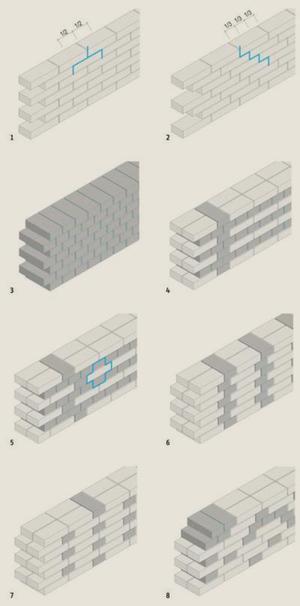
- Medium runners' bandage: The bandage consists exclusively of layers of runners that are offset by half a stone's length from each other.
- Dragging runner bandage: The bandage consists exclusively of layers of runners that are offset by a third of a stone's length from each other.
- Truss bond: The bond consists exclusively of layers of trusses that are offset by half a stone's width from each other.
- Block bond: Layers of runners and binders alternate. The butt joints of the similar layers are always on top of each other.
- Cross bandage: It is derived from the block bandage. Every second rotor layer is offset by one head. In addition, the layer structure remains the same as in the block bond. The "cross" becomes visible when a runner is viewed with a cobblestone in the middle above and below.
- Gothic bandage: In each shift, runners and binders alternate. Often the butt joints of every second layer sit on top of each other, in the other layers they are offset by half a truss
. - Märkischer Verband: In each shift, two runners take turns with a binder.
- Wild Association: The seemingly wild arrangement is subject to fixed rules. The butt joints must be offset by at least a quarter of a runner's length, there may be a maximum of 5 runners in a row. Occasional steps should not exceed 3 to 5 steps.
Source: bauwion